Control System Design: A Practical Guide
Control systems are the invisible brains behind everything from your car's cruise control to industrial processes. When poorly designed, they turn precise machines into unpredictable messes. This guide breaks down control system design with clear theory and actionable steps, perfect for engineering students ready to build reliable systems.
Why Control Systems Matter (And Why Yours Might Fail)
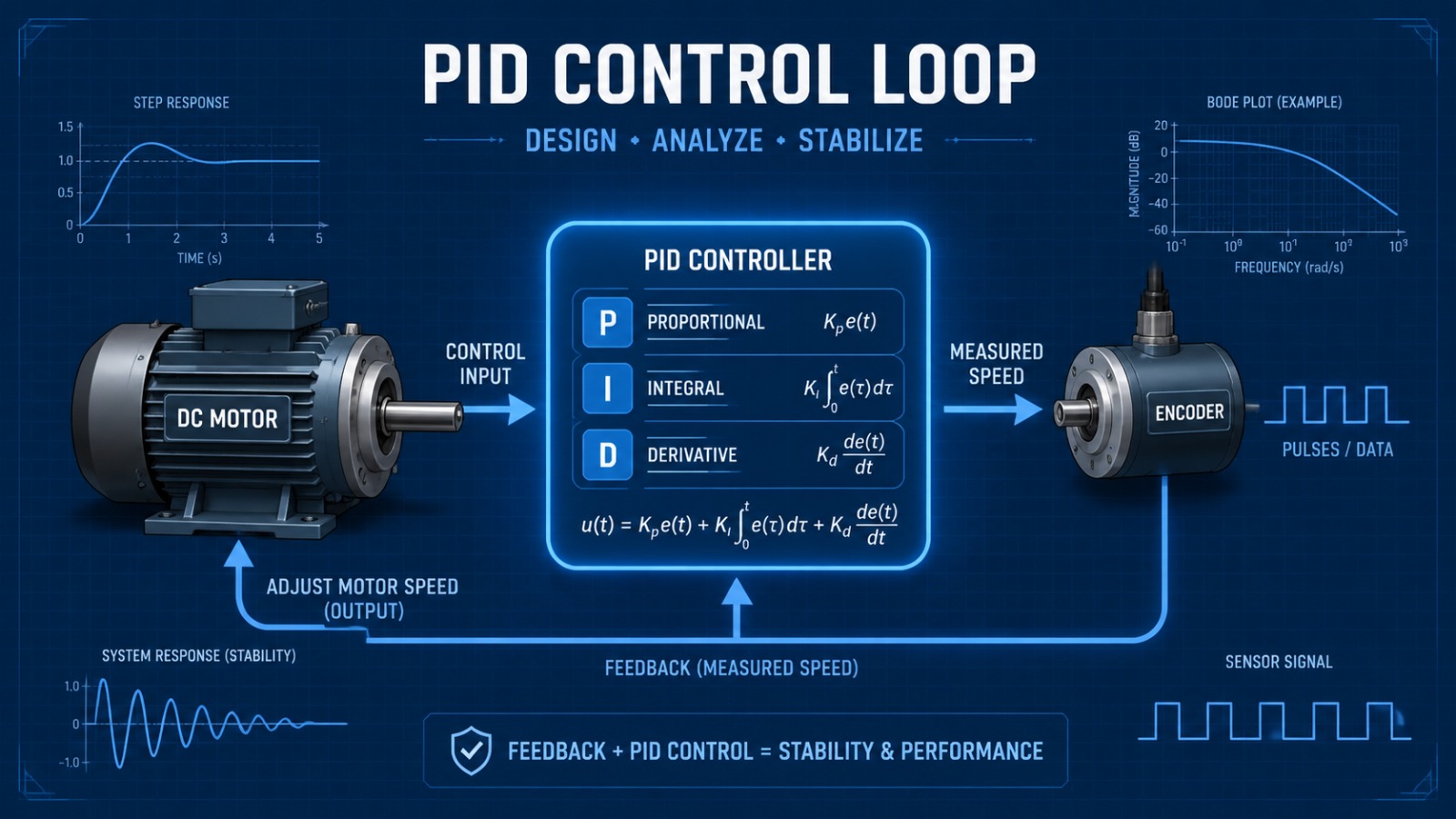
Picture commanding a motor to hit exactly 1000 RPM, only for it to overshoot, oscillate, or drift. That's bad control design at work. Fundamentally, a control system compares a setpoint (desired value) with the actual output (from sensors), then tweaks actuators to minimize error.
Core components:
Plant: The physical system (motor + load).
Controller: The algorithm deciding corrections.
Sensors: Feedback like encoders or thermocouples.
Actuators: Motors or valves making changes.
It's a high-speed loop: sense → compute → act → repeat. Mess it up, and chaos follows.
The PID Powerhouse: Your Everyday Controller
PID (Proportional-Integral-Derivative) is the go-to for most applications—simple yet powerful:
Proportional (P): Output scales with current error. High gain causes ringing; low gain means slow response.
Integral (I): Builds up past errors to fix steady-state offsets (e.g., load-induced droop).
Derivative (D): Dampens by predicting error trends.
Tune with Ziegler-Nichols: push P until oscillation, then calculate optimal gains. Real-world starting points: P=1-10, I=0.01-1, D=0.1-5.
Beyond PID: Level Up Your Designs
For complex systems, graduate to:
State-Space Control: Handles multi-variable dynamics with matrix math—ideal for coupled systems.
Model Predictive Control (MPC): Predicts ahead, optimizing against constraints like actuator limits.
Fuzzy Logic: Intuitive rules (e.g., "IF error large AND changing fast, THEN output strong") for nonlinear plants.
Add feedforward for known disturbances, like wind on a drone
.
Stability and Tuning: Keep It Rock-Solid
Prioritize stability. Use Bode plots (gain/phase vs. frequency) or root locus analysis—target >45° phase margin.
Pitfalls and fixes:
Noise? Apply low-pass filters.
Delays? Boost sampling rate.
Nonlinearities? Linearize around operating points.
Simulate first (MATLAB/Simulink), prototype second. Tools like root locus reveal hidden instabilities before hardware bites.
Take Control Today
Mastering control systems means turning theory into machines that perform. Grab a motor, implement PID, tune iteratively—you'll see sluggish setups snap to life