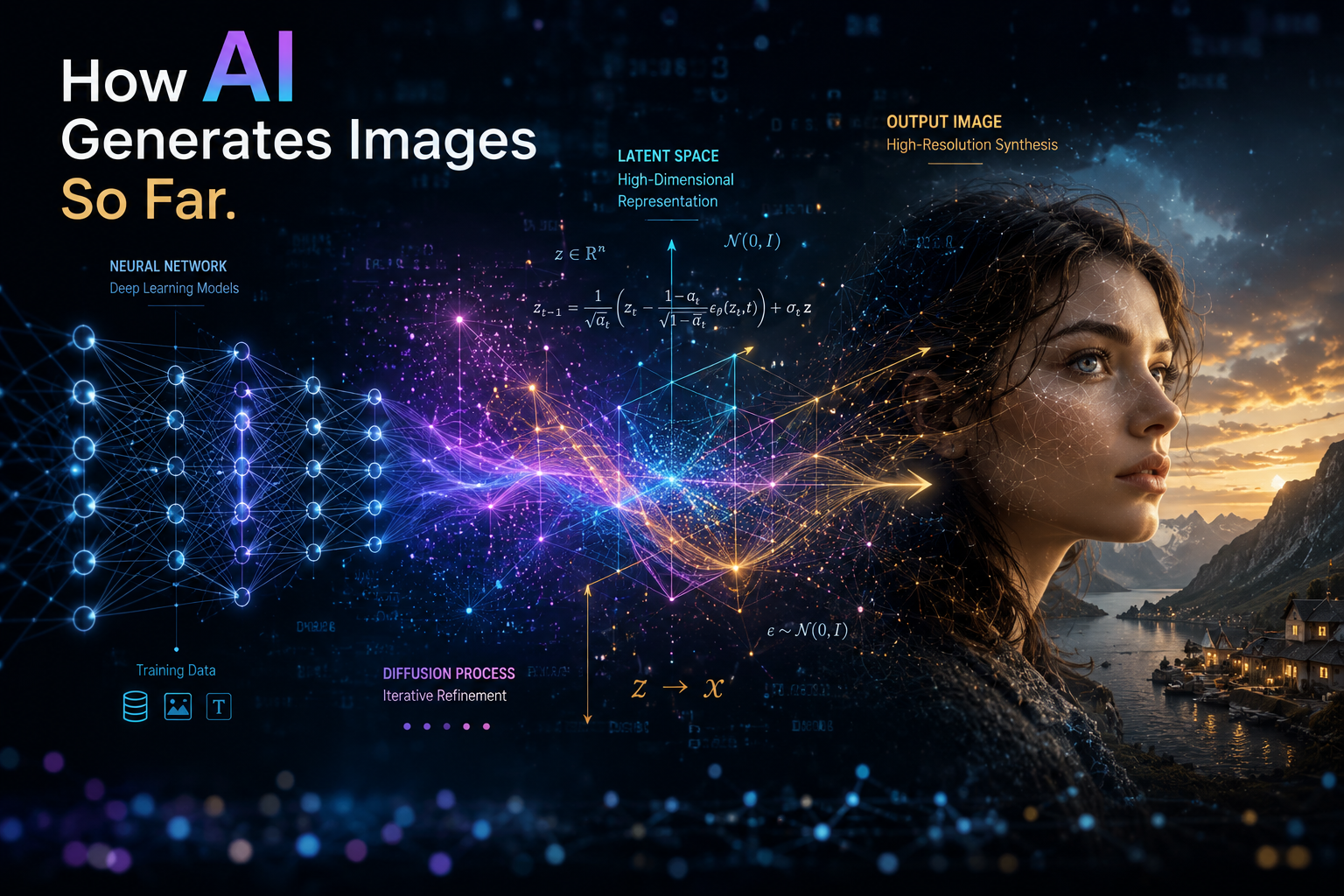
As AI professionals, we have witnessed an astonishing, almost exponential, evolution in generative technologies over the last decade. We have moved from coarse, low-resolution pixel-based outputs to high-fidelity, photorealistic, and stylistically precise imagery. To understand where this technology is heading, we must first analyze the sophisticated journey of "how we got here." This post provides a professional retrospective and a look at the current dominance of Diffusion models.
Part I: The Architectural Roots – GANs and Autoregression
The foundation of the modern era of image generation rests on key architectural breakthroughs, each solving unique constraints.
1. Generative Adversarial Networks (GANs): The Competitive Birth. Introduced in 2014 by Ian Goodfellow et al., GANs defined the first phase of realistic generation. Their architecture was brilliant in its simplicity: a Generator network created an image, and a Discriminator network attempted to classify it as 'real' or 'fake.' The competition forced the generator to produce incredibly realistic details. Though often challenging to train and prone to "mode collapse," variations like StyleGAN paved the way for high-resolution human face generation.
2. VQ-GAN and the Importance of Codebooks. As the complexity of requested images grew, a major challenge emerged: computational efficiency. Standard GANs struggled with large, high-resolution global structures. Approaches like Vector Quantized GAN (VQ-GAN) solved this by creating a discrete visual codebook. The generation task effectively became an autoregressive (step-by-step) prediction, similar to how language models predict the next word. This allowed large-scale models, like the first iteration of DALL-E, to understand complex visual relationships for the first time.
Part II: The Current Epoch: The Rise of Diffusion
While GANs excelled at detail and speed, the field was revolutionized by the emergence of Diffusion Models (as popularized by papers like Ho et al., 2020), which now power nearly all state-of-the-art systems including DALL-E 3, Midjourney, and Stable Diffusion.
The Core Mechanism: De-Noising.
A Diffusion model operates on a principle radically different from GANs. Instead of starting with random noise and immediately attempting to draw an image, the training process is reversed:
Forward Process: A high-quality image is gradually destroyed by adding sequential steps of Gaussian noise until it is unrecognizable static.
Reverse Process: The model is then trained to undo this damage. It learns, step-by-step, how to accurately remove noise from a noisy input.
The power of this architecture is its stability and scalable control. Because the generation is iterative, we can introduce complex steering mechanisms (like text prompts, or even ControlNets) at every single de-noising step, ensuring the final output is both visually coherent and aligned with the user’s intent.
Part III: The Modern Stack: Text, Tokens, and Latent Space
To generate an image based on "A cat wearing sunglasses on Mars," modern models execute a complex multi-stage pipeline:
Text Encoding (The Bridge): Your textual prompt is first converted into machine-readable embeddings (numerical lists) using a frozen language model (like T5 or CLIP).
The Generation Engine (U-Net): In models like Stable Diffusion, the iterative de-noising process happens in Latent Space—a highly compressed, mathematical representation of visual concepts. An architectural component known as a U-Net, combined with self-attention mechanisms, applies the de-noising guided by the text embeddings.
Decoding (The Canvas): Finally, a special model called a VAE Decoder takes the finalized latent representation and decompresses it back into the high-resolution pixel space we see as the final image.
Conclusion
So far, the journey of AI image generation has been defined by moving from pure competition (GANs) to sophisticated reconstruction (Diffusion). We have successfully mapped the vast vector space of language directly into pixel space. As we move forward, the focus is shifting from simple 'generation' to advanced controllability—adding temporal consistency for video, precise spatial composition, and deeper architectural efficiency. We are no longer just making pictures; we are engineering visual information.