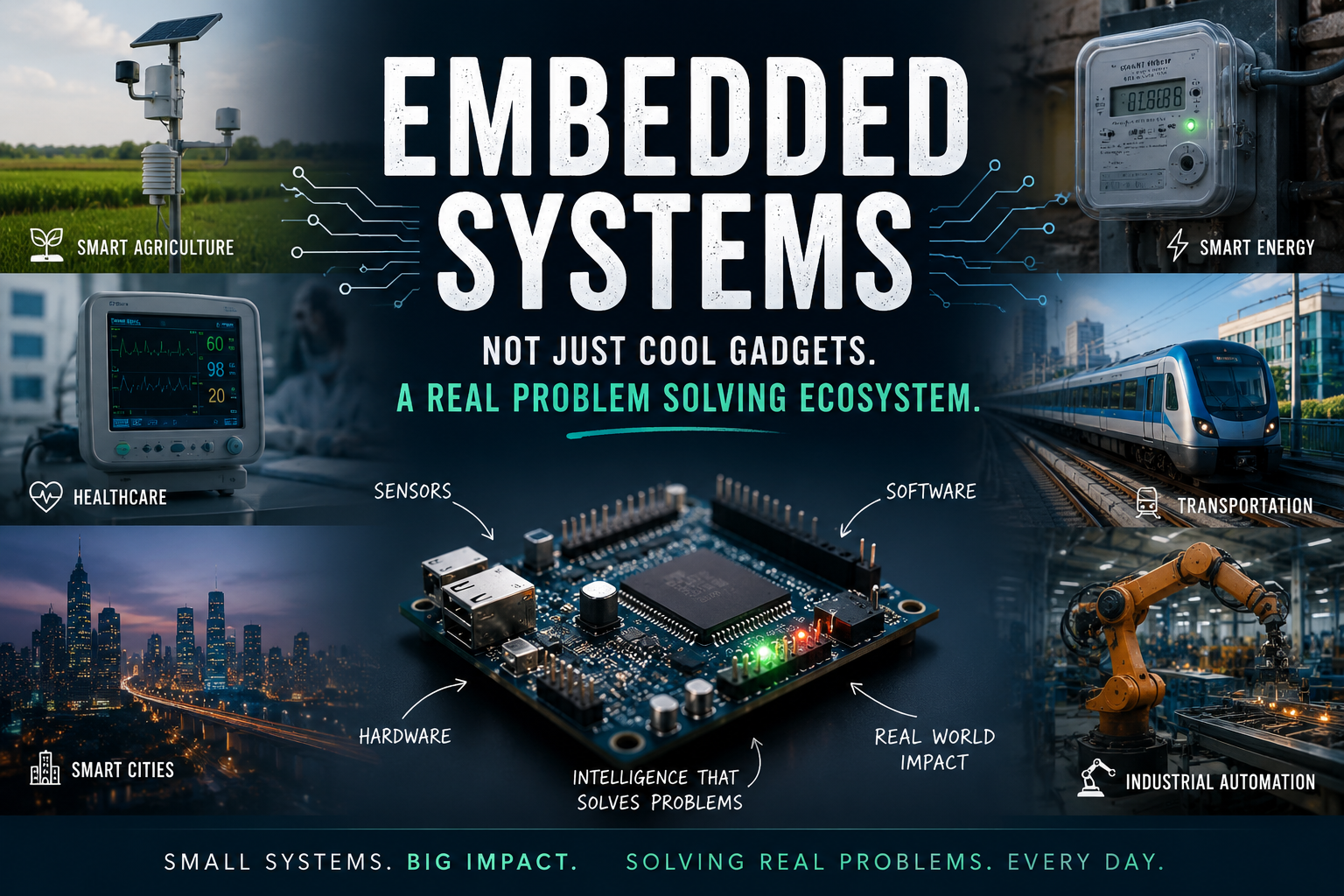
When people think about embedded systems, they often imagine hobby projects, blinking LEDs, smartwatches, or fancy robotics demonstrations. While those applications are exciting, they represent only a very small part of what embedded systems actually are.
In reality, embedded systems form the technological backbone of modern infrastructure. They are deeply integrated into healthcare, transportation, industrial automation, agriculture, defense, energy systems, and smart infrastructure. Their purpose is not just to “look advanced,” but to perform dedicated tasks reliably, efficiently, and in real time.
An embedded system is essentially a combination of hardware and software designed for a specific function within a larger system. Unlike general-purpose computers, embedded systems are optimized for particular operations such as sensing, monitoring, controlling, communication, or automation.
A typical embedded system consists of:
Microcontrollers or microprocessors
Sensors and actuators
Memory units
Communication interfaces
Power management systems
Real-time software or firmware
Together, these components allow machines to interact directly with the physical world.
This is what makes embedded systems fundamentally important.
They act as the bridge between digital intelligence and physical reality.
For example, in industrial automation, embedded controllers continuously monitor parameters like temperature, pressure, motor speed, and vibration. Based on sensor feedback, the system can instantly adjust machine operations without human intervention. In such environments, latency, reliability, and deterministic behavior are critical. A delay of even milliseconds can affect productivity, safety, or equipment lifespan.
That is why many embedded applications operate using Real-Time Operating Systems (RTOS), where tasks must execute within strict timing constraints.
The same principle applies to the automotive industry.
Modern vehicles contain dozens of Electronic Control Units (ECUs) responsible for functions such as:
Anti-lock braking systems (ABS)
Engine management
Airbag deployment
Battery management in EVs
Advanced driver assistance systems (ADAS)
These systems continuously process sensor data in real time. For instance, an airbag control system must detect collision conditions and deploy airbags within milliseconds. This level of responsiveness is only possible through optimized embedded architectures.
Healthcare systems also heavily depend on embedded technology.
Devices such as ECG monitors, infusion pumps, ventilators, wearable health trackers, and portable diagnostic machines rely on embedded processors for accurate sensing and real-time data processing. These systems are designed with high reliability because failure is not acceptable in critical medical environments.
Similarly, embedded systems are transforming agriculture through precision farming.
IoT-enabled embedded devices can monitor:
Soil moisture
Temperature
Humidity
Nutrient levels
Water flow
Microcontrollers process this sensor data and automatically control irrigation systems, reducing water wastage and improving crop productivity. In a country like India, where agriculture remains highly dependent on environmental conditions, such systems can directly improve resource efficiency and sustainability.
Energy infrastructure is another major application area.
Smart meters, smart grids, and power monitoring systems use embedded electronics for:
Real-time energy measurement
Fault detection
Remote monitoring
Load balancing
Theft detection
India’s rapid smart meter deployment demonstrates how embedded systems are becoming part of national-scale infrastructure rather than isolated consumer devices.
One of the most important aspects of embedded systems is their ability to operate under constraints.
Unlike desktop systems, embedded devices must often function with:
Limited processing power
Low memory
Low energy consumption
Compact physical size
High reliability requirements
Harsh environmental conditions
Designing systems under these constraints requires optimization at both hardware and software levels. Engineers must carefully balance performance, power efficiency, cost, and reliability.
This is why embedded engineering is fundamentally different from traditional software development.
Embedded systems engineering involves:
Hardware-software co-design
Interfacing protocols like UART, SPI, I2C, CAN
PCB design
Signal processing
Sensor integration
Power electronics
Real-time programming
Low-level debugging
As AI and IoT continue growing, embedded systems are becoming even more important.
Artificial Intelligence alone cannot interact with the physical world. AI requires sensors to collect data, processors to compute decisions, and actuators to perform actions. Embedded systems provide this complete interface between intelligent algorithms and real-world execution.
For example:
A self-driving car requires cameras, radar, LiDAR, embedded processors, and motor control systems.
A smart factory requires industrial controllers, machine vision systems, and edge computing devices.
A medical AI system requires embedded sensors and real-time monitoring hardware.
Without embedded hardware, AI remains only a software model without physical interaction capabilities.
This is exactly why semiconductor technology and embedded electronics are becoming strategically important worldwide.
For India, this represents a major opportunity.
The future will not belong only to software-centric innovation. It will belong to integrated systems engineering — where electronics, embedded systems, AI, robotics, IoT, and automation work together to solve practical problems at scale.
Embedded systems are no longer just a niche engineering field.
They are becoming the foundation of intelligent infrastructure.
And perhaps that is the most important thing to understand:
Embedded systems are not designed merely to make devices smarter.
They are designed to make systems more reliable, efficient, autonomous, and capable of solving real-world problems in real time.