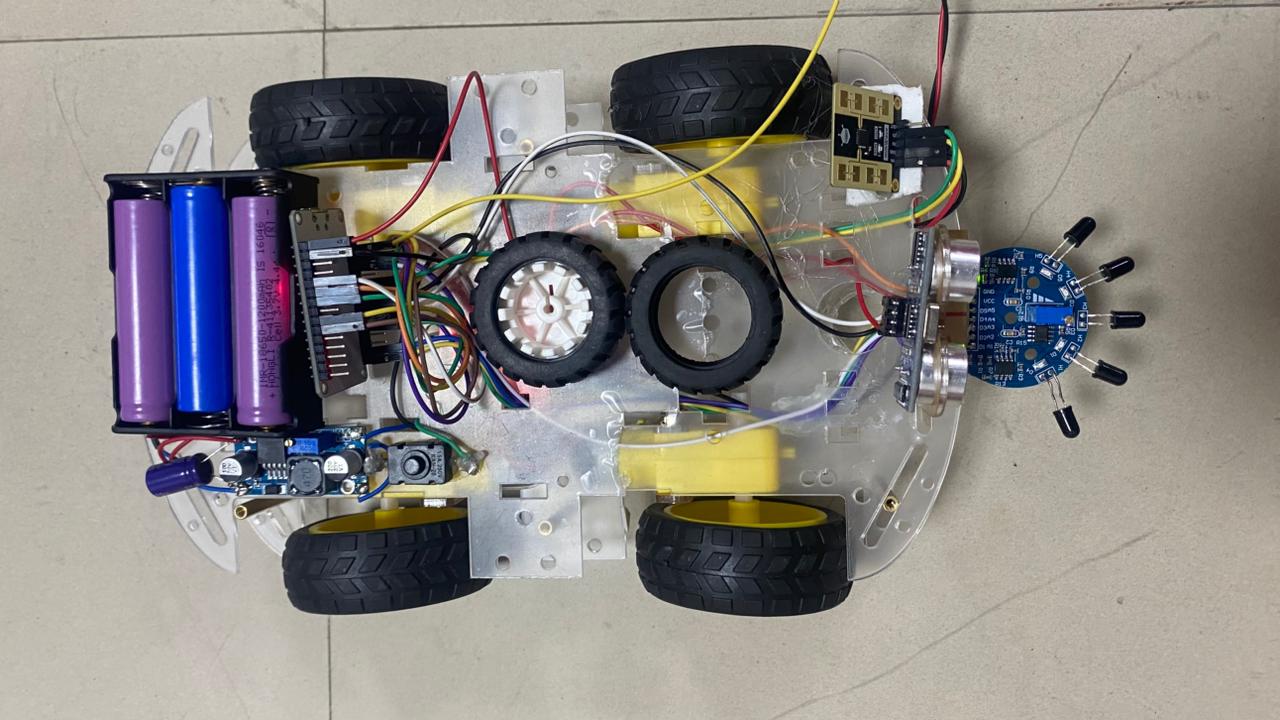
AUTONIX: Autonomous Acoustic Fire Suppression & Deep-Rubble Rescue Rover
AUTONIX is an advanced first-responder robotics system engineered to operate in zero-visibility disaster zones, tackling fires and extracting trapped victims without causing secondary structural or water damage. Traditional firefighting methods rely on high-pressure water or chemical foams, which frequently destroy sensitive server installations, electrical grids, and expensive industrial infrastructure. AUTONIX introduces a non-destructive paradigm by deploying highly targeted low-frequency acoustic pressure waves (40–60 Hz) to disrupt the oxygen envelope surrounding a flame, neutralizing it instantly. Operating autonomously, the rover utilizes a sensor-fusion edge architecture to navigate hazardous environments, mapping debris while detecting the micro-movements of human breathing and heartbeats through thick smoke and rubble.
Ract.js
Django
WebGL / Three.js (for real-time 3D wireframe radar mapping)
WebSockets API
Web Serial AP
C++ (Arduino Framework / PlatformIO)
FreeRTOS
ESP32 hardware LEDC API
ArduinoJson
mmWave Radar
ESP32-CAM AI-Thinker module
L298N Motor Drivers
IRLZ44N Power MOSFETs
Edge Processing Architecture: Powered by a dual-core ESP32 microcontroller operating on a custom FreeRTOS task architecture, isolating the real-time sensor polling loop (Core 1) from the high-frequency Wi-Fi/WebSocket uplink (Core 0) to guarantee zero watchdog timeouts.
.Non-Destructive Suppression Payload: Integrates a high-power acoustic driver driven by an IRLZ44N logic-level MOSFET. The ESP32 utilizes its hardware LEDC PWM API to push precise 40–60 Hz square waves at a 50% duty cycle, displacing air mass through an airtight resonance enclosure to starve flames of oxygen.
.Sensor Fusion & Hardware Telemetry: * Life Detection: Integrates a military-grade mmWave radar operating via non-blocking UART to parse human vital signs (respiration/heartbeats) through solid barriers.
.Navigation: Employs an HC-SR04 ultrasonic array for automated collision avoidance (halting at a strict <30cm threshold) and a 5-channel directional flame sensor array to dynamically compute flame approach vectors.
.Dual-Mode Failsafe Communication: Streams live JSON telemetry (<5ms latency) and ESP32-CAM MJPEG HTTP video to a custom Mission Control dashboard over high-speed WebSockets. It features an integrated Web Serial API fallback, allowing first responders to pull direct physical USB telemetry if local Wi-Fi infrastructure completely collapses.
.Strict Power Isolation: Engineered with dedicated power rails to prevent brownouts. The 12V high-current acoustic payload and L298N motor drivers are galvanically isolated from the sensitive 3.3V/5V microcontroller logic lines, united exclusively by a shared common ground bridge.